
A New Look
If this is not your first visit and you look very carefully, you may be able to see that this blog has morphed slightly.
Dimensional Art Org is now running in the newest version of Joomla which is a content management system (CMS) for creating web sites. Previously it was hosted in WordPress, another CMS. There are many reasons for the change that are off-topic for here.
An improvement is every post will have the opportunity for comment. It will require registration and a few security hoops to hop through, but that is the way it is these days. I would like to see some genuine feedback.
I used the same format as the old system and all the previous content was moved here. The original creation dates were lost but that is not critical for my purposes. I hope you like the change, I do…
What is handmade?
 I have discovered there is no easy answer to that question. I have seen it asked in many creative environments and the answer is never a single universal consensus. Just do a search on the internet and you will see and read what I say is true.
The issue begins and the answer changes with using a tool to aid the use of ones hands in making something. A sharp rock (flint) is considered a tool when it is used for human controlled cutting. So has that somehow diminished the definition of handmade primitive arrows? Another rock (a tool) was used to bash the sharp edges on the arrowhead. But the tools were actually handmade from available “raw” materials.
So… perhaps handmade must include the use tools? Handmade tools? No commercial made steel edge tools? I could expand on this line of thought but I proclaim that “pure” handmade is a very extreme limitation to be a part of modern interpretation of the handmade definition.
But there is another expansion into the use of machines. Does the use of a sewing machine prevent a man’s dress suit from being handmade? Probably. How was the cloth made? The term of preference is hand tailored to avoid the conflict with handmade.
One generally accepted definition is that handmade includes any tool or machine that is directed solely by the human hand. So this conveniently includes purchased or non-handmade tools and machines. It doesn't mention a powered machine... Hmmm.
I am actually not proposing any fix for the purest meaning of hand made. I am making my point that it is not a well-defined concept to the casual user of the term. What is handmade depends on whom you ask. Jewelry has a precise trade definition as found in this Wikipedia search. Does the definition infer the use of automated (automatic directed) machinery used to produce “finding” like clasps and chains and factory beads or even automated wire drawing (sizing), that should preclude the use of the term “handmade” in the jewelry business? So be it. The Wikipedia link may be defective as I certainly consider lost wax silver casting from hand carved wax as “handmade”. So even this example demonstrates the ambiguity of creating a one size fits all definition.
Perhaps it’s like defining pornography, “You know it when you see it.”
I understand the intent and tradition of the archaic term “handmade”. I personally make handmade items I believe to be within the definition. I may also add non handmade items like the necklace chain to finish the project. So there can be a mix.
I also make many items using my mind and hands on a computer input devise to store personally created directions that guide automated machines to do things my hands and limited muscle control cannot manage. These items are just as personally created (note the change in definition) as my handmade items. I can easily NOT refer to these items as handmade.
However, the machines are strictly limited to doing what I direct by the hand programing. So I can argue that I directly control what the machine produces, but breaking “hand” tradition is not worth the fight. I am happy with traditional handmade and love to work within the perceived definition, just because it is traditional.
I also do not feel less of a creative person using my modern definition of personally produced items using computer numeric control (CNC) machines.
Personal CNC makes precision dimensioned components from my human directed inputs. As far as single person art, it is still as pure and traditional as it can be, because I control all the steps. I have total design control. The final machine execution is automatic but there is total human effort in creating the machine movement.
Including automation in handmade is more a concept of creativity control verses human muscle control. I can honor the difference.
So I will leave the term handmade as a sacrament to muscle control in the creative process. My choice of the words “personally created” will include any creative process under total control of myself.
A Time to Get Serious
I have taken the big step and retired from my construction and energy management career. Now begins the time when I get serious about further developing and exploiting my artistic desires. The key word in the previous sentence is time.
Time is a very valuable resource that is already receiving lots of external pressure. I have mentally set some priorities and limits on my time. Now fully into retirement (all 6 weeks of it at this writing) I see time has to be managed as much as ever. It can easily be squandered.
I place time management at a high priority, but I will admit not as critical as when working within a large corporation. I like being my own boss again. I am going to enjoy my retirement and not create high pressure critical path time goals. I just need to manage my time and not let it manage me.
An old adage is still true. Practice makes perfect. My new abundance of time allows me to practice my artistic desires. I am far from perfect and consistent practice is the key of improvement, same as an audition at Julliard. A different kind of art, but the path to acceptance is the same.
My goal is to be an accepted artist. I can claim it all I want but it is really something that has to be earned. Practice will get me there. I am getting serious… ;)
Bellering Idiot
 I have a new passion that is growing out of my desire to be creating something very unique and artful. It is the making of small bells from silver, brass, bronze, bell metal, whatever works. My desire is to highly detail the bell as well as the decorative handle or top part. There are almost unlimited possibilities. I will be using lost wax as well as machining on my Taig Micro CNC mill and lathe.
The largest bell that I will be able to run on my Taig mill will be two inches in diameter at the wide end. That limitation is created because of the depth that I am able to go inside the bell. I have to allow room between the mill bed and the spindle face for how I hold the bell and the length of the milling bit so I can clear the end of the wax cylinder before I start the internal milling. I have only four inches between the spindle nut and the face of the bottom chuck mounted on the table. Half that distance is the total height of the bell if I have to use an up to two inch long mill.
The fact is that I will be making bells of smaller diameter depending on the ratio of bell diameter and bell height. So with a two inch diameter bell the ration is 1:1 (d:h). That will make a 1:2 ration bell a maximum diameter of one inch. I am thinking most standard looking designs will fall between those two ratios. But then I am not going to limit myself to any standard design. The only limit is that it has to fit on the machine.
There is one other design limitation and that is the wax master has to fit inside one of my casting flasks with enough room for the required investment thickness. There are many sizes of flasks available so it is not a critical design concern with the size masters I can make on the Taig mill.
I am planning for the top part of the bell to be a screw on assembly. That will give me absolute freedom to design whatever I want to finish off the top. The bell bottom becomes the support or base for whatever I design for the handle. That is another whole design area to explore.
The screw on handle also provides a way to design the clapper hanger inside the bell. That can be a machined part like a loop with screw threads. The hole drilled in the top of the bell can be smooth or threaded. I see the design coming together! The clapper can be a turned or a cast part.
I do need to start a design book with graph paper so I can sketch ideas to scale. When I have something I like then I can take it to the CAD and make the actual working drawings. In a few weeks I plan to have an example to show here. This category is sure to grow!
Success
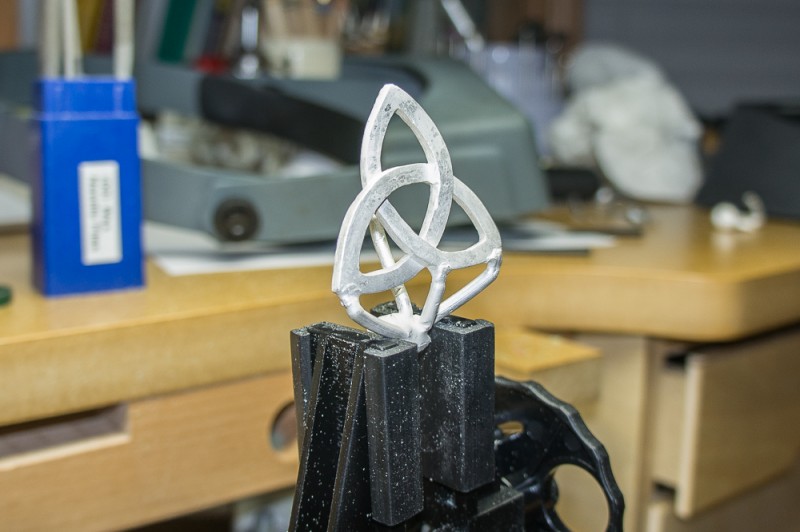
I am referring to lost wax casting in Silver.
It hasn't been a year yet but it is getting close. That’s when my adult daughter and I decided to take a course on wax carving and lost wax casting. We picked the training because it is something I have dreamed of doing for many years. What a joy to take the class together.
After that exposure I knew this was something I could really enjoy with my present health, keeping my hands and mind busy and being able to work while sitting down, for the most part. I decided and vowed to acquire all the tools to do the job at home.
I love hand tools and the detail work, and we bought what we needed to start the class. But now I also needed a few big items to do it all myself.
The first was the kiln that had to go to at least 1400 degrees. Of course I studied everything available. That’s part of the enjoyment, the education process. The Paragon (brand) kiln I bought will easily go to well over 2000 degrees. That gives me enough heat to try other high temperature crafts. This was the biggest expense. I think I invested well.
Next was the casting machine. Initially I was going to go centrifugal casting. I may still go there. But I definitely need a vacuum pump and chamber to degas the investment. There are some alternatives to vacuum degassing, but vacuum is the de facto standard. Plus it works with the vacuum assist casting process.
Centrifugal casting has been put on hold for now and my first good cast proves vacuum works. Of course I need a lot more good casts under my belt. I see clearly that centrifugal is the best choice for small lightweight and intricate casting. It is on my eventual want list. With centrifugal, the force is with me or at least works for me.
The last big hurtle was the comfortable place to do the many hours of wax carving. Since I brought it inside out of the Texas outdoor climate I am like a pig in a mud puddle, totally immersed in what I am doing and loving every minute of it.
Right now I am still refining my skills at wax carving. I will be exploring deeper in to CNC carving as my fingers start to misbehave. But I will take what I can get from my hands for as long as I can.
All the other investment in tools and material has come in small increments over the last 10 or so months. This first successful casting has a lot of time, effort and cost behind it. But all that will be amortized over a whole lot more production. It really isn’t the cost per item that I think about. It is all about the doing.
It demonstrates why handmade art does not and will not compete with mass production as far as cost per piece. The price of silver is only one factor in a long list of total value. Just knowing the person who has made an item adds tremendously to the intrinsic value. Owning something made by a factory assembly line is not the same fuzzy personal feeling as something produced by an artist, craftsperson or personal friend. For me as I have written elsewhere, I think what I make for family and friends provides an heirloom that includes a bit of spirit of the creator, me.
Subcategories
Computer Art
Most of my tangible "Dimensional Art" starts with a concept sketch. sometimes that's all that needed for a conventional woodworking project. Sawing up boards and assembling. A far greater number of dimensional "objects" projects are created with the aid of Computer Numerical Control (CNC) and requires a digital art drawing produced on a computer.
This category contains posts on by artistic efforts with Computer Assisted Design (CAD) Fusion360, Rhinorcerous, Vectric Aspire, DeskProto, others; and 2 and 3 dimentional computer graphics software such as Blender, ZBrush and others.
These working drawings are a form of 'Dimensional Art" in their own right!